Dhaka //
Emphasizing the need to advance agro-processing and agricultural export industries to complement food security, the Prime Minister stated that a robust rural economy is key to building a strong Bangladesh. She remarked, “Agriculture is the cornerstone of our economy. We are making technology, irrigation, agricultural financing, and market linkages for agricultural products more accessible. We are providing support to the fisheries and livestock sectors as well as rural entrepreneurs. We must advance agro-processing and agricultural export industries to complement our food security efforts. I believe that a strong rural economy can build a strong Bangladesh.”
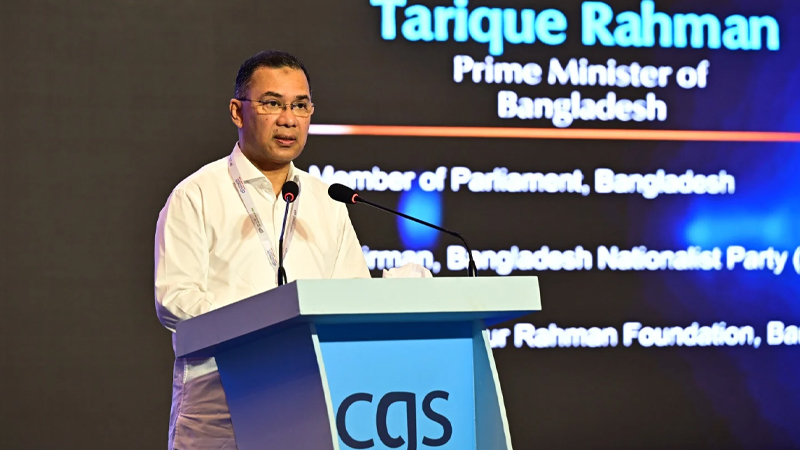
She made these remarks yesterday, Saturday (October 3) morning, while addressing the inaugural ceremony of the international dialogue ‘Bay of Bengal Conversation 2026,’ held at the Grand Ballroom of the Pan Pacific Sonargaon Hotel in the capital. Organized by the Center for Governance Studies (CGS), this three-day international dialogue is taking place under the theme: ‘Fragments, Frontiers, Futures: Navigating Power, Technology, and Trust in a World Rewritten.’
At the beginning of her speech, the Prime Minister thanked the Center for Governance Studies for organizing the ‘Bay of Bengal Conversation 2026.’ She noted that a newly elected government has assumed office in Bangladesh with a massive public mandate. “We have a five-year action plan to implement that mandate. Our priorities include safeguarding national interests, maintaining policy continuity, ensuring economic stability, and undertaking institutional reforms. We are now moving forward with the implementation of our pledges,” she said.
She added, “We are transforming Bangladesh into an attractive destination for investment. Simultaneously, we are developing the country into a robust hub for manufacturing and investment. We aim to generate massive employment opportunities across all sectors, including manufacturing, services, and exports.” Policy certainty is essential for investors, and the continuity of our long-term policies will provide that assurance.
The Head of Government stated that our social safety net programs have been designed to prioritize the most disadvantaged people. Financial assistance will be delivered directly to mothers in every family via ‘Family Cards,’ starting with the poorest and most marginalized communities. ‘Farmer Cards’ will connect farmers to government incentives, agricultural services, and market systems. ‘Health Cards’ will ensure medical care for all, while ‘Universal Cards’ will allow citizens to access integrated government services under a single umbrella.
Emphasizing the need to bring healthcare to every household, she noted that we are working to recruit 100,000 health workers, approximately 80 percent of whom will be women. They will provide primary medical care, health advice, and necessary referral services at the grassroots level. Simultaneously, we are placing special emphasis on maternal and child health.
The Prime Minister mentioned that the current government is working to ensure a joyful learning environment. She stated that culture, sports, values, and ethics would play a vital role in the curriculum to shape the character of our children. There will also be opportunities for them to learn a third language. Alongside general education, technical and vocational education will be expanded. Our government will provide free uniforms, school bags, mid-day meals, and scholarships starting from the first grade. Furthermore, we are extending the scope of free education for girls up to the undergraduate level.
Tarique Rahman considers the country’s water security to be equally important. He stated that we have adopted a plan to dredge 20,000 kilometers of canals and waterways over the next five years. We are advancing the Padma Barrage project to facilitate water conservation and management. Additionally, we are formulating the Teesta Master Plan. These measures will support the agricultural sector and enhance climate resilience.
Noting that the current government has specific targets for environmental protection, she stated that 250 million trees would be planted over the next five years. “We are expanding the use of solar power. Bangladesh is playing a pioneering role in waste recycling and the establishment of eco-friendly ‘green factories’; indeed, 53 of the world’s top 100 LEED-certified factories are now located in Bangladesh. By building clean and eco-friendly cities, we can reduce waste, achieve climate resilience, and further invigorate the national economy.”
The Prime Minister emphasized that strong state institutions are essential for development. “We are strengthening institutional transparency and accountability. Human rights, democratic values, and freedom of expression must be safeguarded. The rule of law must apply equally to every citizen. We aim to foster an institutional culture where state institutions are genuinely dedicated to serving the people of Bangladesh.”
Referring to the Rohingya crisis, the Head of Government stated that Bangladesh is simultaneously fulfilling a major global responsibility. “We continue to shelter approximately 1.2 million Rohingya refugees. Our primary objective is to ensure their swift, voluntary, safe, dignified, and sustainable repatriation to Myanmar. This requires sustained political support and funding from the international community. It is also crucial to address the root causes of the crisis; a crisis that originated in Myanmar must also be resolved within Myanmar.”
The Prime Minister remarked that the Bay of Bengal has shaped our destiny for generations. “Due to Bangladesh’s geographical and strategic location, our seaports, waterways, and coastal economy can connect with the entire world. There is immense potential in shipping, fisheries, tourism, energy, and regional supply chains. We must transform our shared geographical location into shared prosperity within the region, which requires deeper bilateral and multilateral engagement.” Stating that Bangladesh believes in dialogue, partnership, and mutual respect, Tarique Rahman affirmed, “We will safeguard our national interests and sovereignty. At the same time, we will continue to work constructively with all our regional and global partners, as peace and harmony form the foundation of shared prosperity and development.”
He expressed the hope that the Bay of Bengal region would evolve into an area where every nation flourishes together, enjoys mutual and equitable benefits, and citizens extend the hand of meaningful cooperation. Bangladesh stands fully prepared to play its due role in this regard.
Read the news and share your views.
Please Share This Post in Your Social Media