Dhaka //
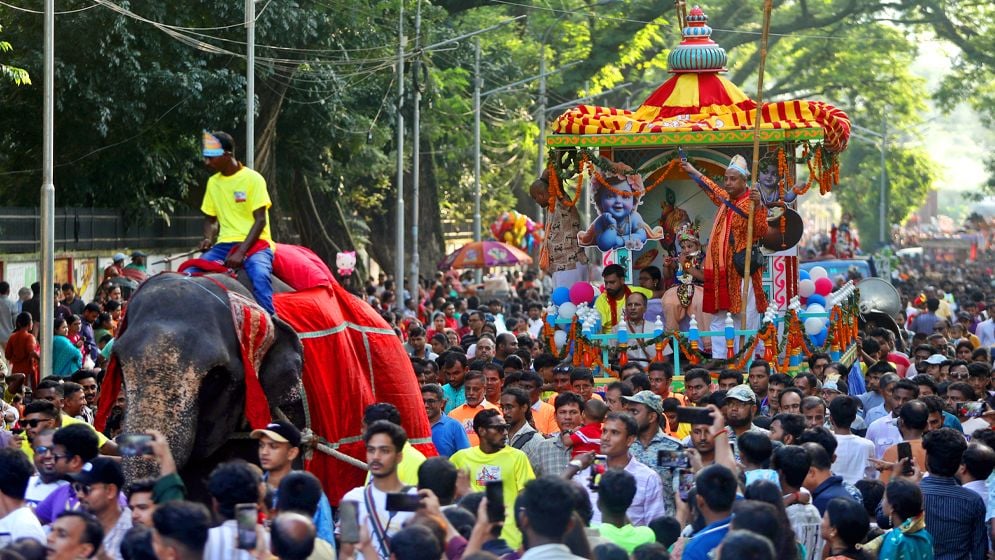
Photo: Collected. Holy Janmashtami—the birth anniversary of Lord Sri Krishna, revered by the Sanatan (Hindu) community—was celebrated with due dignity, religious solemnity, and festive joy. To mark the occasion, various programs were organized across the country, including the capital, Dhaka. These included special prayers for the welfare of the nation and its people, *Sri Sri Gita Yajna* (recitation and ritual offering based on the Bhagavad Gita), colorful processions, discussion meetings, evening *Arati*, *Kirtan* (devotional singing), and cultural events.
The formal observances of Janmashtami began at 8:00 AM on Friday at the capital’s Dhakeshwari Temple with a *Gita Yajna* dedicated to the well-being of the country and the nation. The *Gita Yajna* was conducted by the Shankar Math and Mission of Sitakunda, Chattogram. A colorful procession was a key feature of the festival. The procession was jointly organized by the Bangladesh Puja Udjapan Parishad, the Mahanagar Sarbajanin Puja Committee, and the Dhakeshwari National Temple. Starting from the Dhakeshwari National Temple, the procession traversed a route via Palashi Bazar, Jagannath Hall, Central Shaheed Minar, Doel Chattar, the High Court, Bangabazar, the Dhaka South City Corporation building, Golapshah Mazar, Nawabpur Road, and Ray Saheb Bazar intersection, finally concluding at Bahadur Shah Park.
Around 4:30 PM, Home Minister Salauddin Ahmed spoke as the chief guest at a discussion meeting held at the Palashi intersection to inaugurate the historic central Janmashtami procession. Presided over by Gopal Chandra Debnath, President of the Mahanagar Sarbajanin Puja Committee, the event was addressed by Bijon Kanti Sarkar (Special Assistant to the Prime Minister for Hindu, Buddhist, Christian, and Ethnic Minority Affairs), Md. Abdus Salam (Administrator of Dhaka South City Corporation and Freedom Fighter), Member of Parliament Hamidur Rahman, and Tapan Chandra Majumder (Vice-Chairman of the Hindu Religious Welfare Trust), among others. Following the discussion, the distinguished guests inaugurated the historic central Janmashtami procession by lighting ceremonial lamps.
According to Hindu mythology, Lord Sri Krishna was born on the eighth day of the dark fortnight (*Krishna Paksha*) of the month of Bhadra. Followers of the Sanatan Dharma celebrate this day believing that Sri Krishna appeared on earth—illuminating the lives of his mother Devaki and father Vasudeva within the confines of Kamsa’s prison in Mathura—to vanquish the wicked and protect the righteous. They also believe that the Lord descends among humanity in this manner across different eras to destroy evil and establish truth and beauty.
Huge crowds gather for the Janmashtami procession. Devotees participate in the parade dressed to represent various episodes from Sri Krishna’s life, featuring floats such as Krishna’s chariot, idols of Radha and Krishna, recreations of Kamsa’s prison, and portrayals of figures like Rama, Sita, Lava, and Kusha. To join the procession, devotees arrive from Dhaka city as well as surrounding upazilas—using trucks, mini-trucks, pickups, horse-drawn carriages, and even elephants—gathering at locations like Dhakeshwari Temple and Palashi Intersection. Temples and Hindu organizations across the capital also participate in the procession, presenting various thematic tableaus while maintaining a religious spirit.
Special programs are broadcast on Bangladesh Betar, television, and private satellite channels to mark the occasion. Additionally, various temples, puja mandaps, and religious organizations—including the Ramna Kali Mandir, Bardeshwari Kalimata Mandir in Rajarbagh, and the Mirpur Central Temple—organize events to celebrate Janmashtami.
Stay tuned for regular news updates and share your views.
Please Share This Post in Your Social Media