Dhaka //
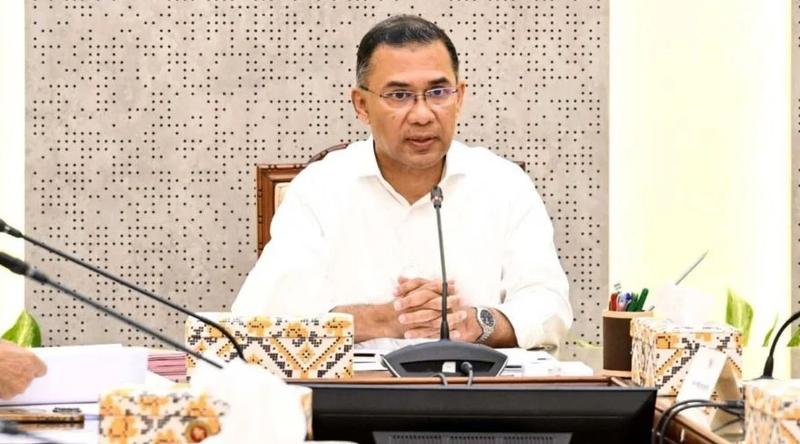
After a long absence of 17 years, the current Prime Minister and BNP Chairman, Tarique Rahman, returned to the country from London on December 25 of last year. On that day, while addressing a mass reception at Purbachal in the capital, he declared, “I have a plan.” This statement sparked public curiosity regarding the details of his plan; however, the Prime Minister had never previously provided a specific explanation for it.
Abu Abdullah M. Saleh, his Press Secretary, has now offered a new explanation regarding the true meaning and underlying rationale behind Tarique Rahman’s widely discussed statement.
Speaking at a “Meet the Reporters” event at the Dhaka Reporters Unity on Thursday, he outlined the Prime Minister’s political philosophy and specific past action plans.
The Press Secretary stated, “When he [Tarique Rahman] stood before a massive crowd upon his return and said, ‘I have a plan,’ it was not a spontaneous political slogan or a casual remark. It was the result of a long-considered and specific vision for the state.”
Elaborating on the backstory of this plan, he noted that on July 15, 2014, while serving as the then-Acting Chairman of the BNP at an event in East London, Tarique Rahman had declared that if the BNP were entrusted with governing the state, the government job quota system would be reformed. At that time, he had announced a specific plan to reduce the existing quota to below 5 percent.
Saleh Shibli pointed out that the quota reform plan he unveiled in 2014 laid the groundwork for the movement that began in 2018 and ultimately succeeded in 2024. The ability to perceive the aspirations of the people a decade in advance and formulate plans accordingly is the true hallmark of a visionary leader.
Emphasizing the importance of establishing one’s own dignity in both political and social life, the Press Secretary remarked that there is no glory or pride in asserting one’s existence by disparaging another person’s family or talking about others. Politics is not merely about rallies, meetings, or belittling opponents; rather, building a beautiful society is possible through the preservation of individual and family dignity.
The Press Secretary also recalled that during Tarique Rahman’s time in London, the broadcast of his statements in the media was prohibited due to court injunctions issued during the tenure of the previous Awami League government. However, overcoming all obstacles and hurdles, the vision for the state and the action plans he articulated—backed by the people’s mandate—are now being implemented.
Prime Minister’s Press Secretary Abu Abdullah M. Saleh has called for initiatives to curb rumors, hearsay, and misinformation spreading across social media and mass media, while simultaneously upholding press freedom.
He stated that freedom does not mean one can write whatever one pleases. Emphasizing the importance of verifying information—or “fact-checking”—circulating in the media, he urged journalists and various organizations to step forward in this regard.
Saleh Shibli remarked that the Government of Bangladesh supports freedom—specifically, the freedom of the press and media. He noted that while we champion freedom, we must ensure we do not become authoritarian ourselves; freedom does not imply the liberty to write whatever one desires. With approximately 70 million people in Bangladesh now using Facebook, one might feel inclined to write against someone; however, when doing so, it is essential to obtain that person’s statement or perspective.
Dhaka Reporters Unity President Abu Saleh Akon and General Secretary Mainul Hasan Sohel were present at the “Meet the Reporters” event.
Share your opinion.
Please Share This Post in Your Social Media