Dhaka //
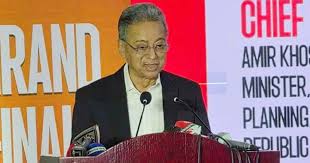
Finance Minister Amir Khasru Mahmud Chowdhury stated that inflation has put pressure on the purchasing power of ordinary people. He also noted that the country’s economy is navigating several challenges, including tax collection falling far short of requirements relative to GDP, the need to restore confidence in the banking sector, and the imperative to boost investment and employment.
He made these remarks on Saturday while addressing the grand finale of ‘Econothon 2026’—a national inter-university economics competition—held at United International University (UIU) in the capital.
Highlighting the uncertainties of the global economy, the Finance Minister said, “When we look at the global economy, uncertainty appears to be the new normal. Global growth is slowing, the cost of financing is higher compared to the last decade, and protectionism and tariff barriers are rising in international trade. Geopolitical conflicts have made energy and transport costs volatile. Climate change is also adding new figures to annual economic losses. Economies like Bangladesh—which are import-dependent and export-oriented—face the direct impact of these global shocks.” He noted that these effects are visible in commodity prices, the exchange rate of the Taka, and export orders for the country’s factories.
Addressing the issue of uncertainty in policymaking, Amir Khasru said, “For us at the Ministry of Finance, every day brings an element of surprise. The budget is formulated based on certain projections, but then come shocks like fuel price hikes, foreign currency pressure, floods, or global market uncertainties. We have to make decisions while remaining accountable to the public, often working with incomplete data and limited time.”
Describing the domestic situation, the Finance Minister said, “Domestically, we stand at a critical juncture. Inflation has strained the purchasing power of the common people; tax collection relative to GDP is far below our needs, and restoring confidence in the banking sector is urgent. Boosting investment and employment is now the top priority.” “At the same time, preparing to graduate from the list of Least Developed Countries (LDCs)—regardless of the timeline—will compel our exports to survive through competitive strength rather than relying on trade privileges. There is no point in hiding problems; acknowledging them is the first step toward a solution.”
He further added, “Our priorities are therefore clear: restoring macroeconomic and price stability; making the tax system fair, simple, and technology-driven; establishing good governance in the banking sector; improving the environment for private investment; and ensuring the best possible return on every penny of public money spent on education, health, and social safety nets. Things will not be fixed overnight, but we remain steadfast in pursuing these goals.”
Regarding the preparations for LDC graduation, the Finance Minister stated that, irrespective of the schedule, the national economy must be readied to align with changing global and domestic realities.
Addressing the students participating in the competition, he said, “The ability to think under pressure, adapt to situations, and defend one’s position with logic is a crucial skill for policymaking.”
Read the news and share your views.
Please Share This Post in Your Social Media