The Daily Morning Sun Online //
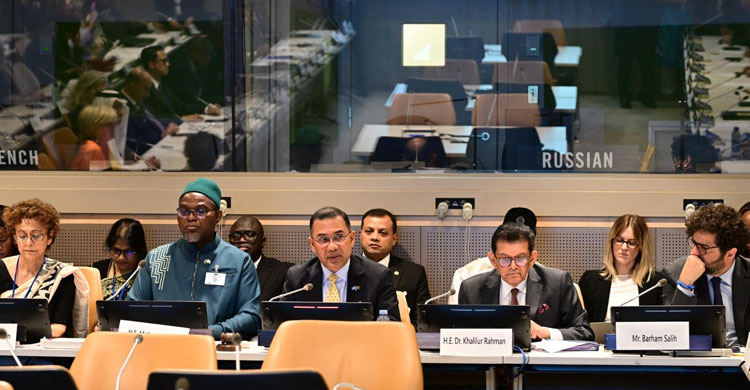
Prime Minister Tarique Rahman attended a high-level meeting on the Rohingya crisis in New York on the sidelines of the 81st session of the UN General Assembly.
The meeting began at 11:15 AM local time yesterday, Wednesday (September 23), in a conference room at the UN headquarters.
“Thank you all for joining us at today’s event. I sincerely thank The Gambia for co-organizing this with Bangladesh, and all partners for standing by us as co-hosts in a show of solidarity.”
At this high-level event, Prime Minister Tarique Rahman emphasized the need for a sustainable and permanent solution to the Rohingya crisis, noting that for decades, the Rohingya people in Myanmar have been victims of discrimination, persecution, and deprivation. Bangladesh witnessed several major waves of Rohingya arrivals in 1978 and throughout the 1980s. Successful repatriation arrangements were made during the tenures of the governments led by the late President Ziaur Rahman and, subsequently, former Prime Minister the late Begum Khaleda Zia. However, the overall crisis situation deteriorated further following the violence in Myanmar in 2017.
Tarique Rahman stated that for over nine years, Bangladesh has shouldered a massive humanitarian responsibility. We continue to shelter more than 1.2 million Rohingya people. Tragically, people are still fleeing due to violence in Myanmar. Thousands of children are born in the camps every year. Consequently, another generation is being added to this protracted displacement. Mothers dream of a safe future; young people are growing up amidst uncertainty; and the elderly harbor a longing to return to the homes and villages they were forced to leave behind.
The Prime Minister noted that Bangladesh opened its borders out of humanitarian necessity. Food and healthcare are being provided to the Rohingya in Bangladesh’s camps. Through approximately 6,000 learning centers, their children are receiving education based on the Myanmar curriculum. Rohingya youth are also receiving capacity-building and skills development training. This process will prepare them for their eventual reintegration into Myanmar’s Rakhine State. We are making every effort to improve conditions in the camps; however, these are not ideal places for long-term habitation.
Tarique Rahman stated that the cost of prolonged displacement is rising daily—not only for the Rohingyas but also for the local host communities in Cox’s Bazar. The social, economic, environmental, and security pressures on Bangladesh are now immense.
He noted that prolonged uncertainty and despair are giving rise to new challenges and security risks, including human trafficking, migrant smuggling, drug trafficking, and other transnational crimes. Some are even risking their lives to travel to Malaysia by boat. A crisis left unresolved in one country can evolve into a security challenge for the entire region. Yet, even as needs grow, the lifeline of humanitarian aid is shrinking. The Joint Response Plan for 2025 appealed for over US$934 million in aid. For 2026, that request has been reduced to approximately US$710 million—an amount intended solely to meet minimum life-saving needs. This trend cannot continue. We are deeply grateful to the international partners who have consistently stood by Bangladesh; we need their support now more than ever. However, generosity in humanitarian aid cannot serve as an excuse for political inaction. Similarly, it cannot be expected that Bangladesh alone will bear this responsibility indefinitely.
The Prime Minister stated that the crisis originated in Myanmar, and its solution also lies within Myanmar. Regrettably, the internal situation in Rakhine State remains deeply concerning. Rohingyas continue to face severe violations and abuse, including forced recruitment, arbitrary detention, restrictions on movement, forced labor, and other forms of insecurity. Reports indicate allegations of serious violations by both the Myanmar military and the Arakan Army. Consequently, conditions conducive to safe and dignified repatriation have not yet been established.
He stated that the time has come to move beyond mere empathy toward identifying the root causes of the crisis and finding solutions; to transition from pledges to concrete actions; and to shift from managing displacement to ending it altogether.
Tarique Rahman said, “Against this backdrop, I would like to propose urgent measures in five areas. First, international and regional stakeholders must formulate a clear and credible roadmap for the rapid, safe, voluntary, dignified, and sustainable repatriation of the Rohingyas to Myanmar. The international community and other states must assist in efforts to establish stability and leverage their influence to create conditions within Myanmar that are conducive to repatriation. Second, violence against the civilian population of Myanmar, including the Rohingyas, must cease. The fundamental rights and security of the Rohingyas in their homeland must be guaranteed so that they regain confidence in returning. Third, the international community must ensure adequate and predictable humanitarian assistance for the Rohingyas. Support must also be extended to the local host communities; their aspirations for development should not be hindered by their generous hospitality. Fourth, justice and accountability are essential for sustainable repatriation. We are deeply grateful for The Gambia’s leadership in seeking accountability at the International Court of Justice. At the same time, we acknowledge the vital role of the International Criminal Court, alongside other international judicial and investigative mechanisms addressing individual criminal liability. Continued support must be provided to these international judicial and investigative processes. Those responsible for grave crimes must be held accountable. Fifth, regional and international cooperation must be further strengthened to combat the drug-based economy, human trafficking, digital fraud, illicit arms trade, and other cross-border crimes that fuel instability in the region.”
The Prime Minister stated that Bangladesh does not want the Rohingyas to remain displaced forever. We want them to return to their homes in Myanmar safely, voluntarily, and with dignity, while having their rights secured. Bangladesh has fulfilled its responsibilities guided by humanitarian principles. Now, the international community must also fulfill its responsibilities with firm resolve. If the necessary conditions are created, Bangladesh stands ready to assist in their repatriation. Let us ensure together that the fate of the Rohingyas does not become yet another tale of persecution, expulsion, and displacement; instead, let it become a story of justice, dignity, and hope. And most importantly—let this story begin right now.
Stay connected with the news and share your views.
Please Share This Post in Your Social Media