Dhaka //
There is no alternative to safe food to ensure nutrition. The main cause of our nutritional problems is unsafe food. And consuming unsafe food causes malnutrition among children and pregnant mothers. Again, 5 percent of people are suffering from diarrhea every day due to consuming unsafe food.
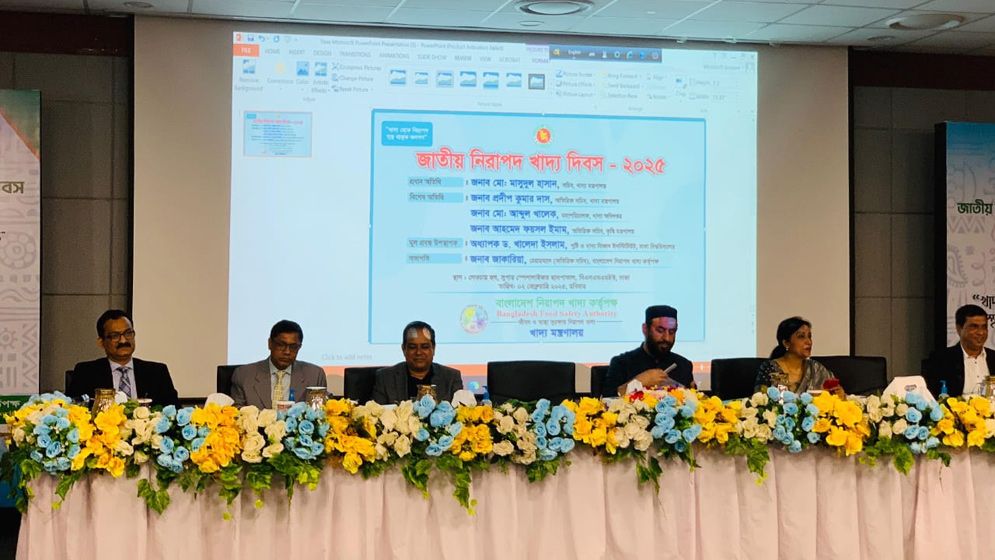
The speakers said these things at a seminar organized to mark the National Safe Food Day 2025.
The seminar was organized by the Bangladesh Food Safety Authority (BFSA) at the lecture hall of the capital’s Super Specialized Hospital on Sunday morning. This year, the theme of the day has been set as ‘Let the food be safe, let the people be healthy’.
BFSA Chairman (Additional Secretary) Zakaria presided over the event, with Food Secretary Md. Masudul Hasan as the chief guest, Additional Secretary Pradeep Kumar Das as the special guests, Director General of the Food Directorate Md. Abdul Khalek, and Additional Secretary of the Ministry of Agriculture Ahmed Faisal Imam as the special guests. The keynote address was delivered by Dr. Khaleda Islam, Professor of the Institute of Food and Nutrition Sciences, Dhaka University (DU).
Food Secretary Md. Masudul Hasan said, “Food, health and wellness cannot be viewed separately. They complement each other. And to stay healthy, we must consume safe food. Because the question of how safe the food of 700 billion people in the world is today has arisen.”
He said, “5 percent of people are suffering from diarrhea every day due to consuming unsafe food. In the current world, our food security is not being ensured for various reasons. Even vegetables are being affected by econite infection, and it is difficult to export these abroad. I hope that a direction will emerge from today’s seminar through discussions.”
In his welcome speech, BFSA Chairman Zakaria said, “Today, we are working on three things together. Among them are the 10th anniversary of the Safe Food Authority, and a project worth Tk 2,400 crore has been approved by ECNEC for the Safe Food Authority subject to certain conditions. Moreover, I am going to get land allocation from the Public Works Department to set up a lab in Khulna.’
She said, ‘According to the World Health Organization, 80 people die daily and 30,000 people die annually due to diarrhea in our country. One of the reasons for this is consuming unsafe food. We have created a Ludo game room to motivate children to eat safe food. So that awareness about food safety increases among them.’
Dr. Khaleda Islam said, ‘Food becomes unsafe due to bacteria, chemicals, glass fragments, etc. Moreover, it is also unsafe due to water-borne viruses and toxic substances. One in 10 people gets sick due to this food. 420,000 children under the age of five die in the world due to consuming unsafe food. 35,000 people die annually in Bangladesh due to unsafe food.’
She said, citing the data of the Bangladesh Food and Nutrition Institute in 2021, ‘There is a lot of adulteration in our food. Ghee contains 66.67 percent adulteration, jaggery 43.75 percent, honey 33.33 percent, sweets 28.57 percent, turmeric 27.93 percent, pulses/chickpeas 5 percent, rice 8.33 percent, chilli 14.63 percent, powdered milk 16.67 percent and salt 17.33 percent.’
Regarding ways to keep food safe, Dr. Khaleda Islam said, ‘To keep food safe, food must be kept clean, cooked and raw food cannot be kept together, cooking must be covered, food must be kept at the right temperature and safe water must be used for cooking.’
Mentioning what kind of food to buy from the market, she said, ‘When buying fruits and vegetables, you must check whether the color is right. You must buy seasonal fruits and vegetables. You cannot buy rotten or smelly food. You must check it with your hands. In the case of oil, you must check the amount of fat.’
The seminar was attended by about 200 people, including representatives from the Ministry of Food, academics, researchers, doctors, food traders, civil society representatives, and media workers.
Express your opinions.
Please Share This Post in Your Social Media