Dhaka //
Professor Rehman Sobhan, a prominent economist and former advisor to the caretaker government, has commented that development has always been pitted against the environment. He said that environmental protection activities are being hampered due to lack of proper implementation of laws. This requires concerted efforts and initiatives. However, first of all, a special commission must be formed to determine what to do in this regard.
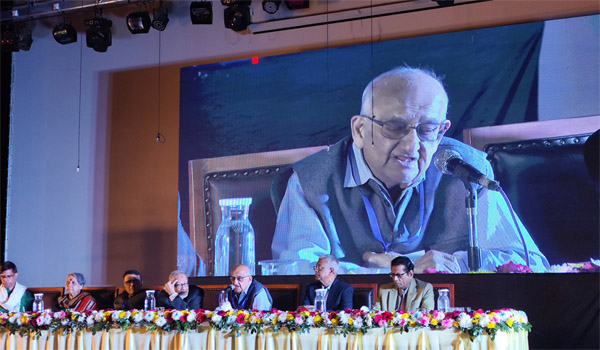
Rehman Sobhan said this at the inauguration of a two-day special conference organized to mark the 25th anniversary of the Bangladesh Environment Movement (BAPA). The conference was jointly organized by BAPA and Bangladesh Environment Network (BEN) at the TSC Auditorium of Sher-e-Bangla Agricultural University in the capital on Friday.
In a separate session of the same program, Environment Advisor Syeda Rizwana Hasan said that Bangladesh is going to sign the International Rivers Act. The government will finalize a master plan for Teesta.
At the inauguration ceremony, Rehman Sobhan said that environmental protection is possible only by following the existing laws and international norms of the country. Excessive profits and market economy are the main reasons for environmental destruction. He said that due to the market economy, the price of land has increased abnormally. Due to this, housing is being built by occupying rivers, wetlands and forest lands. This is destroying the environment. He mentioned that the influence of black money is also responsible in this case.
Rehman Sobhan expressed hope that the interim government will take positive steps to protect the environment. He said that the advisor in charge of the Ministry of Environment is himself an environmentalist. He has already taken positive initiatives to protect the environment. However, the government has formed commissions and special committees on various issues. But no steps have been taken on important issues like the environment yet. He urged the interim government to take quick action in this regard.
Rehman Sobhan praised the involvement of the citizens of Bangladesh in environmental protection. He said that despite citizen involvement, many are agitating from different platforms. As a result, although there are many modern and sophisticated laws in the country, their benefits are not being realized due to lack of proper implementation. If we want to achieve benefits, we need to bring everyone on the same platform. Through this, it will be easier to create pressure on the government.
Rehman Sobhan said, the Kaptai Hydropower Project was dreamed of playing an important role in solving the country’s energy problems. But in reality, it was not fulfilled; rather, a large number of ordinary people in that region have become refugees. Our environment has also been severely damaged. We must get out of projects that destroy the environment.
BAPA President Nur Mohammad Talukder presided over the inaugural ceremony. BEN founder and BAPA Vice President Nazrul Islam presented the concept paper.
In the concept paper, Nazrul Islam said that through the work of the last 25 years, BAPA and BAPA have built a huge knowledge base about the country’s environmental problems, which is working as an important source of information for environmental research and discussion in the country. However, BAPA still has to sail upstream. Stating that it is difficult to continue the culture of environmental protection work based on self-financing and voluntary work, he said that this work requires joint efforts and cooperation.
In his speech as president, Nur Mohammad Talukder said that although BAPA has achieved many achievements in its long 25-year journey, an effective environmental movement has not developed throughout the country. All over the country, people affected by local environmental problems are agitating, many of whom BAPA has not been able to reach.
After the opening ceremony of the conference, the working session began. The first session discussed ‘BAPA and the struggle to protect the environment from the perspective of politicians’, the second session discussed ‘River and water management’, and the third session discussed ‘Air, noise, and visual pollution and waste management’.
In his speech at the first session, Professor Rawnak Jahan said that political parties have started taking environmental problems into account. However, it remains to be seen to what extent those in power consider environmental protection.
Mahmudur Rahman Manna, President of Nagorik Oikya, said that environmental issues are gaining importance among the political leadership because of the environmental movement. Therefore, this movement must continue.
Ruhin Hossain Prince, General Secretary of the Communist Party of Bangladesh, also spoke at this session.
Bangladesh to sign International Rivers Act
Syeda Rizwana Hasan, advisor to the Ministry of Environment, Forests and Climate Change of the interim government, spoke at the closing session. She said that Bangladesh is going to sign the International Rivers Act. For this, the consent letter has been sent to the Ministry of Foreign Affairs. Bangladesh will sign the act only after receiving permission from there.
The environment advisor said that Bangladesh has signed agreements with both India and China on the Teesta. As a result, Bangladesh has found itself in a complicated situation. However, the government will finalize a master plan on the Teesta.
Earlier, Sher-e-Bangla Agricultural University Vice Chancellor Md. Abdul Latif, BEN Global Coordinator Md. Khalequzzaman, BAPA Vice President Mostafizur Rahman, Md. Shahidul Islam and Khushi Kabir, BAPA General Secretary Alamgir Kabir, among others, spoke at the opening ceremony of the conference.
On the second day of the conference, tomorrow, Saturday, three sessions titled ‘Sustainable Urbanization’, ‘Energy, Power and Climate Change’ and ‘Forests, Mountains, Coasts and Indigenous Rights’ will be held. After that, the conference’s proposals will be adopted based on everyone’s opinions.
Please Share This Post in Your Social Media