The Daily Morning Sun Online //
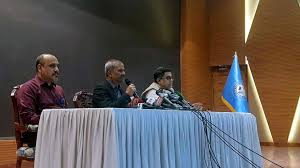
The interim government has no desire to stay in power by wasting time. The government wants to go to elections after completing urgent reforms based on discussions with political parties. And political parties have the right to seek elections. Professor Dr. Asif Nazrul, Legal Advisor to the interim government, said these things at a press conference organized at the Foreign Service Academy in the capital on Saturday.
He said that the implementation of the reform program has started. Some reforms will be made through discussions with political parties. The opinions of political parties will start being taken in mid-February. Discussions will continue even during Ramadan.
Earlier, the six commissions formed for state reforms submitted their full reports to the chief advisor on Saturday. The report made some recommendations on urgent matters for the government. A briefing was organized to inform about those recommendations. It was informed at the event that the commissions’ reports proposed three types of reforms. Among them, short-term, which can be implemented by executive order. Secondly, the medium term, which is implemented based on the consensus of the political parties, and the long term, which will require an elected government or parliament to implement. The Chief Advisor’s Press Secretary Shafiqul Alam and Deputy Press Secretary Abul Kalam Azad Majumder were present at the time.
Asif Nazrul said that the reports of the six reform commissions have been uploaded online. The commissions have talked about reforms at various levels, which can be done before the next election. There is a need for consensus with the political parties on some urgent issues. He said that the six reform commissions have submitted a total of 2,000 pages of reports. These have been uploaded on the website. There, the reform proposals are separated. Out of these, half of the urgent reform proposals can be done within a month. On the issue of the July manifesto, he said that the BNP has prepared a manifesto. Student leaders are showing sufficient restraint in this regard. I hope everyone will try to speed up the process.
In response to a question, he said that the political parties want quick elections. They have the right to say that. But our position has already been made clear. I don’t want to waste time in the government. I want to go to the elections after completing the reforms that are necessary based on political consensus. He also said, “We will consider the proposals that can be implemented in the executive order. However, if the political parties want to discuss these too, the government will discuss them.” Regarding freedom of expression, Asif Nazrul said, “The Awami League is still able to give programs because of the government’s tolerance and freedom of expression and respect for the people’s institutions.” The legal advisor said, “The Public Administration Reform Commission has meant six months as urgent. However, of course, these reforms must be done before the next election. Some of these issues may need to be discussed with the political parties. And some issues are so trivial that they can be done by executive order.
For example, he said, there has been talk of facilitating information provision to trial seekers in every court. There is no need to discuss with anyone for its implementation. The High Court has talked about the Judge Appointment Act. We have already done this. In addition, the urgent recommendation says that a permanent Public Administration Reform Commission must be formed. It is necessary to create a new code of conduct for this sector. All types of government services must be digitalized.
He said, currently the Internal Resources Department and the National Board of Revenue (NBR) are two institutions. The recommendations of the Reform Commission say that the two institutions do not need to be separate. They should be converted into one institution. In addition, the Bangladesh Investment Development Authority (BIDA), Bangladesh Export Promotion Authority (BEPZA) and Economic Zones Authority (BEZA) do not need to be separate. They should all be combined into one. The Reform Commission has talked about two new departments. These are Comilla and Faridpur. It has been said that 10 departments should be reorganized. The Deputy Commissioner should be the District Commissioner and the Upazila Nirbahi Officer should be the Upazila Commissioner. It is necessary to reform the Magistrate Court and the Land Registrar Office at the Upazila level. Currently, the Land Registration Office works under the Ministry of Law and Justice. But other management offices are under the Ministry of Land. This creates a problem in coordination. That is why reforms are necessary here.
Legal Advisor Asif Nazrul said that the six reform commissions have recommended reforms in three phases, short-term, medium-term and long-term. Of these, 50 percent of those that are short-term and urgent can be implemented within a month. He said that political parties have made many reforms in the last 55-56 years. Each party has its own reform ideas. If this doubt is removed among political parties, that these reforms are not for prolonging power, then many things will be implemented. The legal advisor said that the basic conditions for state repair will be met to ensure free and fair elections. We want to go through the election process by implementing the reforms that are necessary on the basis of political consensus.
Asif Nazrul said that about a thousand crore taka was deposited in various private banks in his two ministries. Which are the banks of relatives of former ministers or their affiliated institutions. Padma Bank and Madhumoti Bank are among them. He said, “There is news to bring back these lost money.” No rules or laws were followed during the Awami League period. Asif Nazrul asked why the money of the Expatriate Welfare Bank would be kept in private banks.
Urgent: Out of the six commissions, 5 commissions have made recommendations for urgent action. However, the Constitution Reform Commission has not made any recommendations in this regard. The recommendations of the five commissions include the formation of a permanent Public Administration Reform Commission, public hearings for the formulation of a new code of conduct for government employees and listening to citizens’ complaints, the formation of citizens’ committees, permanent citizens’ committees at the district and upazila levels, reducing the number of ministries, including the Internal Resources Department and the NBR together in one department, making Comilla and Faridpur new divisions, designating the Deputy Commissioner as the District Commissioner, establishing a magistrate court at the upazila level, completely digitizing the sub-registry office, restructuring the Public Service Commission, determining a code of conduct for judicial service members, establishing a separate criminal service for investigating criminal cases, forming commercial courts, appointing auxiliary staff in the courts, establishing an information desk in every court through the Judicial Service Commission, making arrangements for taking police testimony online, formulating rules to avoid political programs on court premises, hiring retired district judges on a contractual basis to reduce the existing backlog of cases, fixing lawyers’ fees, making written contracts and receipts mandatory, having a separate unit for those who will investigate, human rights training for the police and Formulation of a code of conduct, Human Rights Commission to investigate complaints against the police, amendment of the Representation of the People Order, amendment of the media policy, starting testing of online voting, appointment of an ombudsman to implement the national anti-corruption strategy, formulation of a law that black money can never be laundered, practicing transparency and integrity in political and electoral laws, bringing private-level bribery under the purview of the constitution, and taking all measures to further strengthen the ACC are among them.
Incidentally, after the fall of the Awami League government led by Sheikh Hasina on August 5, 1 month and 3 days after the formation of the interim government, Chief Advisor Dr. Yunus announced the establishment of a commission to reform the much-discussed 6 sectors in his address to the nation on September 11. Among them, SUJON (Citizens for Good Governance) Editor Badiul Alam Majumdar was appointed as the head of the Election Commission. The head of the Police Reform Commission is former Public Administration and Home Secretary Safar Raj Hossain, the head of the Commission for Judicial Reform is former Justice Shah Abu Naeem Mominur Rahman, the head of the Commission for Anti-Corruption Commission (ACC) Reform is Transparency International Bangladesh (TIB) Executive Director Dr. Iftekharuzzaman, the head of the Commission for Public Administration Reform is former Advisor to the Caretaker Government Abdul Mueed Chowdhury, and the head of the Constitutional Reform Commission is Professor of Government and Politics at Illinois State University, USA Dr. Ali Riaz. Out of these, 4 commissions submitted their reports on January 15. Two commissions submitted their reports on February 5. The commissions submitted their full reports on Saturday. A press briefing was organized on this report on Saturday. The heads of the commissions are the National Consensus Commission. The head of this commission is Dr. Muhammad Yunus and the member secretary is Professor Ali Riaz. After the report of this National Consensus Commission, the government will soon consult with the main political parties. In the final stage, the outline of the reform idea will be finalized based on a three to seven-day consultation meeting with students, civil society, political party representatives, and government representatives.
Give your opinion.
Please Share This Post in Your Social Media