Special Correspondent //
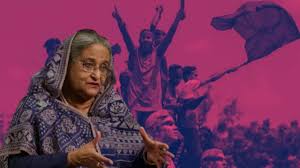
From July 2024 to August 5, 1,581 people were martyred by the bullets of the law enforcement forces and her leaders and activists on the orders of the fascist Sheikh Hasina. A significant number of them were children. In addition, six more people were killed extrajudicially from January 1 to June 30 last year.
On the other hand, from January to August 5, at least 199 people were killed and 6,979 injured in political violence during Hasina’s rule. After Hasina came to power in 2009, during her 15-and-a-half-year rule, she used disappearances and murders as a tool of state oppression to suppress political movements and silence the voices of dissenters and create an atmosphere of fear in the country. At least 20 people were also disappeared in the last five months of Hasina’s power. This information was revealed in the 2024 annual report of the human rights organization ‘Adhikar’. The 54-page report was published on the organization’s website on Monday.
Meanwhile, the family members of those who were killed indiscriminately during the mass movement of students and the victims of disappearances and murders during the 15-year rule and the victims of the student revolution are comparing Hasina’s rule to Hitler. Calling Hasina ‘Lady Hitler’, they said, ‘The dictator Sheikh Hasina planned to destroy the country by taking power in 2009. In continuation of this, the fascist Hasina has committed more atrocities than Hitler for 15 and a half years.’
It is worth noting that Adolf Hitler is the name of a terrible dictator in history. He was elected Chancellor of Germany in 1933. On his orders, the country’s Nazi forces killed many of the opposition. They established a totalitarian and fascist dictatorship. During World War II, the Nazis brutally murdered more than 6 million Jews, from which even innocent children and the elderly were not spared.
The report of Odhikar is divided into three parts. The first part contains the notable part of the authoritarian ruler Hasina’s period from January 1 to August 5, 2024. The second part contains the notable part of the interim government period from August 9 to December 31. And the third part highlights the issues of other human rights violations during Hasina and the interim government from January 1 to December 31. In addition, 10-point recommendations are made to solve the existing problems.
The report states that in order to stay in power, the Hasina government turned all state, constitutional and autonomous institutions into obedient institutions. It also appointed incompetent and party people to control the judiciary. During this time, Hasina completely destroyed the electoral system and established an authoritarian regime. She took away the people’s right to vote by making the 2014, 2018 and 2024 national parliamentary elections and all local government elections opaque, controversial and farcical.
In addition, citizens’ freedom of speech, thought, conscience and expression have been widely violated during Hasina’s tenure. Journalists have been attacked and harassed by Awami League party leaders and supporters and miscreants while performing their professional duties. Until August 5, the repressive Cyber Security Act was used to undermine freedom of speech and expression, freedom of the media, personal privacy and civil liberties. The report also said that violence against women increased in 2024 during the Awami League government.
Persecution and massacre in suppressing the mass movement of students and the public in July-August: The report said that the authoritarian Hasina government fell on August 5 after a mass uprising of students and the public. Sheikh Hasina was forced to flee to India. To suppress this movement, security forces including the police and RAB opened indiscriminate fire and killed many unarmed protesters and ordinary people. To suppress this peaceful movement of the students, the then government deployed members of the Chhatra League, Jubo League, Swechchhasebak League, law enforcement agencies and security forces against the protesting students on July 15. On July 16, a policeman shot and killed Abu Sayeed, a student of Rangpur Begum Rokeya University.
After the killing of Abu Sayeed, students across the country took to the streets. The police, Chhatra League and Jubo League leaders and activists continued to attack them one after another. At this time, the government used the police, BGB and the specialized force Swat against the protesters. The report also mentioned that armored vehicles with UN designations were used to suppress the student-public movement. According to the draft list of the Student Movement Against Discrimination and the National Citizen Committee, 1,581 people were killed in the student-public movement in July-August.
On the other hand, according to the latest figures of the Ministry of Liberation War Affairs, 834 people, including children, have been killed as of January 15, 2025.
105 children killed: When the brutal attack on the protesting students escalated, the local general public, even workers and rickshaw pullers, joined them. Members of the law enforcement agencies and leaders and activists of the ruling party shot indiscriminately at the protesting students and crowd. The Hasina government shut down the internet at various stages of the July-August movement and carried out indiscriminate killings. Members of the law enforcement agencies shot at the students and crowd from helicopters and killed them. The police and the Awami League prevented the students from being taken to the hospital. Many of the injured students died in this. After July 19, 105 children including children Samir, Abdul Ahad, Riya Gop, Mohammad Russell were killed in indiscriminate shooting.
Five hundred and fifty people lost their eyes: The Odhikar report states that after killing the protesters in Ashulia, Dhaka, the police piled their bodies in a van and set it on fire. According to the Health Ministry, 834 people, including children, were killed in indiscriminate and targeted firing by law enforcement officials during the July-August protests as of January 15, 2025. In addition, students, workers, and daily wage workers are among the injured in the firing. At least 550 of them have lost their eyesight. Some of them have had their hands, feet, or other organs amputated to save their lives. A total of 44 police officers were killed during the protests, the report said, citing sources at the police headquarters.
Partisanship of state institutions: The report says that for about 15 and a half years, the deposed authoritarian Hasina government and her party Awami League implemented an extremely oppressive regime. During this time, state, constitutional and autonomous institutions including the Election Commission, the Anti-Corruption Commission and the National Human Rights Commission were used to implement the government’s political plans. Even the judiciary was incompetent and was controlled by appointing party people.
One-party farce elections: The deposed Hasina government completely destroyed the electoral system; which was against the constitution and international law. The people’s voting rights were taken away by making the 2014, 2018 and 2024 national parliamentary elections and all local government elections opaque, controversial and farce. The report also says that the then government’s election commissions were complicit in this misdeed. In addition, in conducting one-sided and farce elections, widespread attacks, cases and elections were conducted on leaders and activists of opposition parties including BNP-Jamaat.
The extent of corruption: The report says that corruption in Bangladesh took a horrific form in every field due to the lack of transparency and accountability in Hasina’s authoritarian regime. From Hasina, her sister Sheikh Rehana and their family members, ministers in her government, MPs and central leaders of the Awami League to grassroots leaders and activists, government officials supporting the government, businessmen, intellectuals and journalists, huge amounts of money were illegally looted and smuggled abroad through widespread corruption.
Repression of the opposition party: Until August 5, the authoritarian Hasina government carried out widespread repression against opposition leaders and activists, dissenters and students. Around each farcical election, the Hasina government filed false cases against opposition leaders and activists and arrested thousands of leaders and activists so that they could not participate in the movement. During this time, Odhikar was accused of torturing and killing BNP leaders and activists. Along with the police, leaders and activists of the ruling party attacked opposition leaders and activists. Ahead of the farcical elections on January 7, 1,800 opposition leaders and activists were sentenced to prison.
Awami League misdeeds and violence: During Hasina’s rule, at least 199 people were killed and 6,979 injured in political violence from January 2024 to August 5, 2024. After the Awami League seized power, its leaders and activists became reckless. Odhikar has received allegations of widespread violence and misdeeds against leaders and activists of Awami League, Chhatra League and Jubo League and other affiliated organizations. Although Awami League leaders and activists have been involved in various violence including murder, most of them enjoy impunity. It also says that there are allegations of setting up torture cells to carry out extortion and terrorist activities of the party against leaders and activists of Awami League and its affiliate organizations.
Human rights violations by Indian Border Security Force: The report says that the Bangladesh-India border has become a bloody border due to the indiscriminate killing of Bangladeshi citizens by the Indian Border Security Force (BSF). In 2024, the Indian Border Security Force (BSF) killed 24 Bangladeshis and injured 29 people. Of the 24 Bangladeshis killed, 21 were shot and three were tortured by the BSF. Of the 29 injured, 26 were shot, 2 were tortured and one was injured by a grenade thrown by the BSF.
India’s aggressive policy: The report says that the Indian ruling class’ aggression in Bangladesh took on a large scale during the authoritarian Hasina government’s tenure. The Indian ruling class widely supported the then government in the opaque and controversial national parliamentary elections of 2014, 2018 and 2024 to exert influence over Bangladesh. As a result, it claims that the Indian ruling class is also largely responsible for the collapse of Bangladesh’s electoral system, the authoritarian regime established in the country, and widespread human rights violations. The report also states that the Hasina government entered into many secret agreements with Delhi that were against the interests of Bangladesh.
The report, which covers the period from August 9 to December 31, 2024, during the interim government, states that the International Crimes Tribunal has begun filing charges of crimes against humanity during Hasina’s authoritarian regime and genocide during the July-August Movement over the past 15 years. After the fall of the Hasina government, political violence occurred. During this time, Awami League leaders and activists were attacked, their homes were vandalized and arsoned. Awami League leaders and activists attacked BNP leaders and activists. Clashes and killings occurred between both BNP and Awami League parties and over dominance in the area. During the interim government, workers held demonstrations, rallies and blocked roads for various demands, including salary increases, payment of arrears, and reopening of factories. Workers clashed with law enforcement and security forces in various places, and one worker was killed in a shootout with law enforcement.
10 Recommendations: The report has made 10-point recommendations to resolve various problems, including the prosecution of the genocide and disappearances mentioned in the report. These are:
1. Confront relevant members of law enforcement agencies involved in genocide, extrajudicial killings, disappearances, torture and inhumane acts. 2. Implement the Torture and Custodial Deaths (Prevention) Act 2013 and follow the directions of the High Court and Appellate Division in the Blast vs. Bangladesh case to stop torture in the name of remand. In addition, the government should ratify the Optional Protocol to the UN Convention against Torture. 3. Enforce disappearance as a crime immediately in accordance with the UN Convention to protect all persons from disappearances. Persons involved in disappearances should be brought to justice regardless of their professional or political status in the armed forces or government. In addition, victims of disappearances who have not yet been found should be located and returned to their families. Victims of disappearances who have already returned should be compensated. 4. Reform the National Human Rights Commission Act in line with the Paris Principles. 5. Allegations of breach of discipline, negligence, corruption and human rights violations by prison officials, regardless of their rank, must be investigated. 6. Freedom of expression and media must be ensured at all levels.
All harassment cases filed against journalists and all human rights activists must be withdrawn and those responsible for attacks on them must be brought to justice, subject to a fair investigation. 7. Immediately repeal all repressive laws, including the Special Powers Act 1974, the Information and Communication Technology Act 2006, the Anti-Terrorism Act 2009, the Cyber Security Act 2023 and the Cyber Security Ordinance 2024. 8. To stop violence against women and children, the perpetrators must be arrested and brought to justice. Arbitration for violence against women must be stopped and the criminal justice system must be implemented to ensure justice for the victimized women. 9. All human rights violations, including killings and torture of Bangladeshi citizens by the Indian BSF along the border, must be stopped and every killing and torture must be prosecuted. In this regard, it is important for the government to put pressure on the ruling class in India. 10. The commissions formed by the interim government must present specific, sustainable, and effective recommendations that can be implemented before the next election.
Express your opinion.
Please Share This Post in Your Social Media