Dhaka //
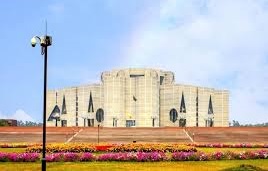
The Parliament Secretariat has started work on the proposed formation of the Upper House as part of the parliamentary system reform. It is planned to use the audience galleries on the fifth floor of the National Parliament House to determine the seating space for the possible 100 members. Initial preparations for this renovation process are underway with the technical assistance of the Department of Architecture and Public Works. However, when asked about this, the officials of the Parliament Secretariat refused to comment due to strategic reasons.
It is learned that the plan is being prepared keeping in mind this alternative idea of finding a place to sit for the 100 members of the Upper House while keeping the design of world-famous architect Louis I. Kahn intact. The main session room located on the third floor of the Parliament House has seating arrangements for 354 people. Of these, 300 are for members of Parliament and 50 are for members of Parliament on reserved women seats. And the remaining four are for technocrat ministers and state ministers. The speaker’s seating area is located outside the session room on the third floor. There are another 100 seats on both sides of it. Judges, heads of the three services, heads of government of various countries, diplomats, foreign delegates, bureaucrats and other important people of the society get the opportunity to sit in these seats and watch the proceedings of the session. This information was revealed in a report published in the Jugantar newspaper on Tuesday (January 27).
The report also revealed that sources said that the Parliament Secretariat initially planned to allocate 100 seats on both sides of the Speaker’s seat for the members of the upper house. But they could not arrange alternative places for the judges, heads of the three services, heads of government of various countries, diplomats, foreign delegates, bureaucrats and other important people of the society to sit. In this situation, an initiative was taken to allocate seating for the members of the upper house by combining two adjacent audience galleries from among the five audience galleries located on the fifth floor of the Parliament building. Necessary renovations will be made for this. Everything necessary, including tables, chairs and sound systems, will be installed. However, several officials of the Parliament Secretariat said on condition of anonymity that the responsibility of taking the final decision in this regard will be left to the next elected government and the Parliament.
Analysts say that after 54 years of independence, Bangladesh is going to enter the era of a bicameral parliamentary system. The 13th National Parliament election is going to be held on February 12. A referendum will be held on the same day in favor of the July Charter. If the ‘yes’ vote wins in this vote, the upper house will be added to the National Parliament for the first time along with the lower house. However, the members of the previously elected parliament will bring the necessary amendments to the constitution on the basis of consensus. The July Charter has set a time limit of 180 working days for this. Immediately after this, the upper house will be formed with members of 100 seats nominated by different parties on a proportional basis (PR); experts believe that this will set a new precedent in the parliamentary system of this country.
In this regard, Badiul Alam Majmudar, Editor and CEO of Citizens for Good Governance (Sujon), said that if the majority vote in the referendum is ‘yes’, a Constitution Reform Council will be formed with the representatives elected in the next parliamentary election. These representatives will also serve as members of the National Parliament. The Council will amend the constitution within 180 working days from the date of its first session. After the constitution is amended, the upper house will be formed within 30 working days according to the number of votes received in the parliamentary elections. He said that its term will be until the last working day of the new house. This upper house with 100 members will be formed in proportion to the votes received by the parties participating in the national parliament elections. Through this, Bangladesh will enter a new era in the country’s parliamentary system of governance.
Meanwhile, before the elections, the Parliament Secretariat initiated experiments on where the 100 members of the upper house would sit in the National Parliament Building. No separate arrangement was made for the members of the upper house to sit inside the National Parliament Building designed by architect Louis I. Kahn. Originally, no one had the issue of the upper house in mind when the seating arrangement inside the parliament building was made. But if the necessary amendments are made to the constitution and the provisions of the upper house are added within 180 working days of the thirteenth national election and the beginning of the parliamentary session immediately after, a new seating arrangement will have to be made. The parliamentary secretariat is working with this in mind. An initiative has been taken to find seating for the 100 members of the upper house while keeping the design of Louis I Kahn intact. The plan is being arranged keeping multiple options in mind.
In the face of the student-public uprising, the Awami League government led by Sheikh Hasina fell on August 5, 2024. Three days later, an interim government was formed on August 8. Nobel laureate Professor Dr. Muhammad Yunus became the head of this government. He took responsibility and formed a National Consensus Commission for the necessary reforms. After long discussions from September 11 of that year, the July Charter was prepared. On October 17, the leaders of the political parties expressed their commitment to the July Charter by participating in the signing ceremony of this charter at the South Plaza of the National Parliament. 25 political parties and alliances signed it. In the July Charter, most political parties agreed to form a 100-seat upper house through proportional representation, or PR, system.
Stay connected with regular news.
Please Share This Post in Your Social Media